How to Validate Your Digital Product Idea Before Writing a Single Line of Code
Most digital products don’t fail because of bad code.
They fail because no one actually wanted them.
Founders often jump straight into building—weeks of design, months of development—only to discover there’s no real demand. Validating your product idea before writing a single line of code is the highest-leverage move you can make.
In this guide, you’ll learn a practical product validation framework used by successful SaaS founders and product teams to reduce risk, validate demand, and build with confidence.
This isn’t theory. These are market validation techniques you can apply immediately—even if you’re non-technical.
Section 1: What Product Validation Really Means (and What It Doesn’t)
Product validation is the process of proving that:
- A real problem exists
- A specific audience cares enough to pay for a solution
- Your proposed solution resonates before you build it
Validation is not:
- Asking friends if they “like” your idea
- Running a single poll on social media
- Assuming competitors = validation
Validation is evidence-based. You’re looking for signals of demand, not compliments.
Plug-and-Play Development Talent for Your Team
The 3 Core Validation Signals
- Pain – Is the problem frequent and urgent?
- Pull – Are people actively seeking solutions?
- Pay – Will they exchange money, time, or effort?
If you can’t prove all three, you’re still guessing.
Section 2: Start With the Problem, Not the Product
The biggest validation mistake?
Falling in love with a solution before confirming the problem.
Before you pitch a feature or build a prototype, get crystal clear on:
- Who the user is
- What they’re struggling with
- How they solve it today
High-Intent Problem Discovery Techniques
- Analyze Reddit, Indie Hackers, and niche forums
- Read negative reviews of competing products
- Study “alternative” search queries (e.g., “X vs Y”, “X alternatives”)
Look for patterns in language.
When people repeat the same frustrations, you’ve found signal.
A validated product starts with a painful, frequent, and expensive problem.
Section 3: Market Validation Techniques That Actually Work
Once you understand the problem, it’s time to validate demand. These techniques are ranked from fastest to strongest signal.
1. Keyword Demand Validation
Search intent reveals real interest.
Use SEO tools to evaluate:
- “validate product idea”
- “[problem] software”
- “[problem] tool”
- “[competitor] alternatives”
High commercial intent keywords = built-in demand.
Signal to look for:
Consistent monthly search volume with transactional modifiers.
2. Smoke Test Landing Pages
A simple landing page beats a full MVP.
Your page should include:
- Clear problem statement
- Promise of outcome (not features)
- One call-to-action (join waitlist, request access, pre-order)
Drive targeted traffic and measure conversion.
Benchmarks:
- 10–20% email opt-in = strong interest
- <5% = unclear positioning or weak problem
3. Pre-Selling the Solution
The strongest validation signal is money.
Options include:
- Paid waitlists
- Founder-led demos
- Early access pricing
You’re not testing scale—you’re testing willingness to pay.
If people hesitate to pay now, they won’t magically pay later.
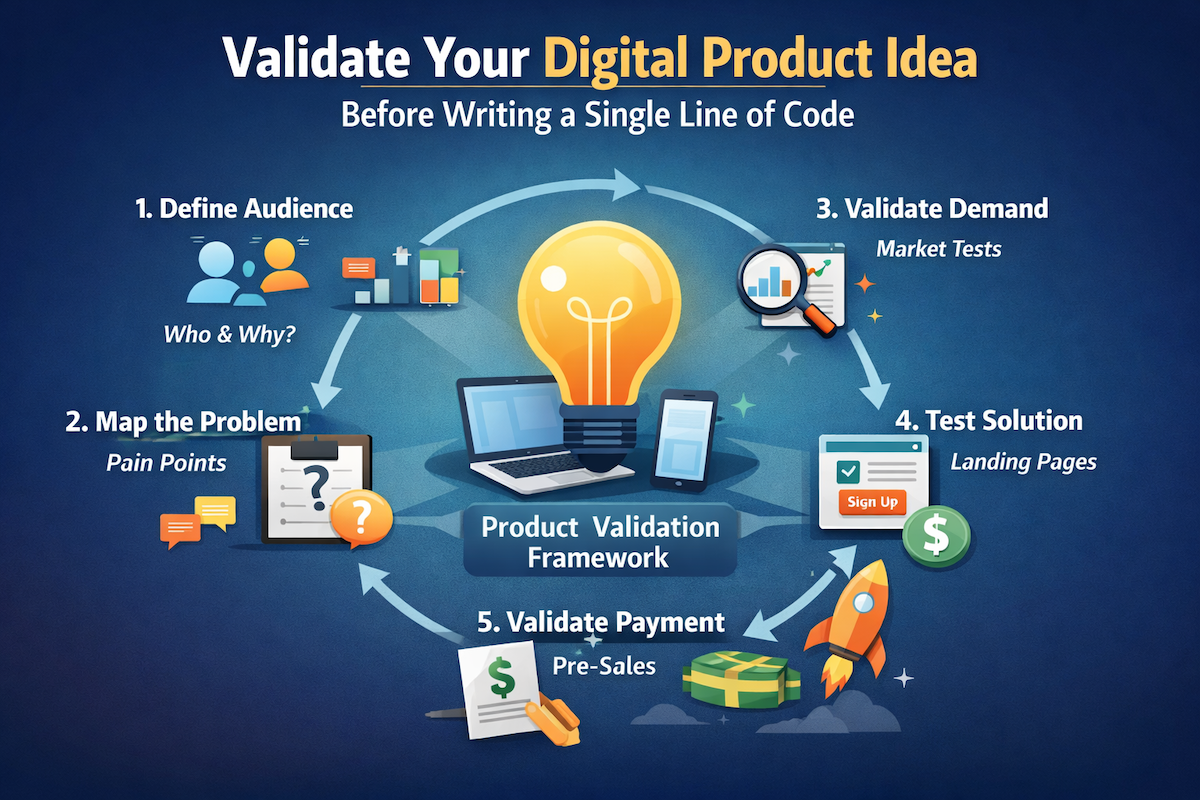
Section 4: A Simple Product Validation Framework (Step-by-Step)
Here’s a repeatable product validation framework you can use for any digital product:
Step 1: Define the Audience
- Role, industry, experience level
- What triggers their pain?
Step 2: Map the Problem
- Current workaround
- Cost of not solving it
Step 3: Validate Demand
- Keyword research
- Community analysis
- Competitor traction
Step 4: Test the Message
- Landing page
- Cold outreach
- Ads with low budgets
Step 5: Validate Payment
- Pre-orders
- Paid pilots
- Letters of intent
Only after these steps should you write code.
Section 5: Validation for SaaS Founders vs Enterprise Teams
For SaaS Founders
- Prioritize speed over perfection
- Validate with no-code tools
- Focus on a narrow ICP
Your goal is learning, not scale.
For Enterprise Teams
- Run structured discovery interviews
- Validate internal alignment early
- Pilot with a small customer cohort
Enterprise validation reduces political risk as much as market risk.
Section 6: Common Product Validation Mistakes to Avoid
- Confusing interest with intent
- Overbuilding “just in case”
- Ignoring negative feedback
- Validating with the wrong audience
Negative signals are not failure—they’re course correction.
FAQ: Product Validation Questions People Actually Ask
What is the best way to validate a product idea?
The best way is to combine keyword research, landing page tests, and pre-selling. The strongest validation always includes a payment signal.
How long should product validation take?
Typically 2–4 weeks. If validation takes months, you’re likely building instead of testing.
Do I need an MVP to validate an idea?
No. Most validation can happen with landing pages, mockups, or demos—before any development.
How much traffic do I need to validate demand?
Even 100–300 targeted visitors can reveal strong signals if your messaging is clear.
Can competitors validate my idea?
Competitors indicate market existence—but not differentiation or demand for your solution.
Conclusion: Build Less, Validate More
Every successful digital product looks obvious in hindsight—but only because validation happened early.
If you validate first, you:
- Save time and money
- Build what people actually want
- Launch with confidence
Before you write code, write proof.
Next step:
Use this framework to validate one idea this week—or explore TechMoca’s product strategy guides to go deeper into execution.